

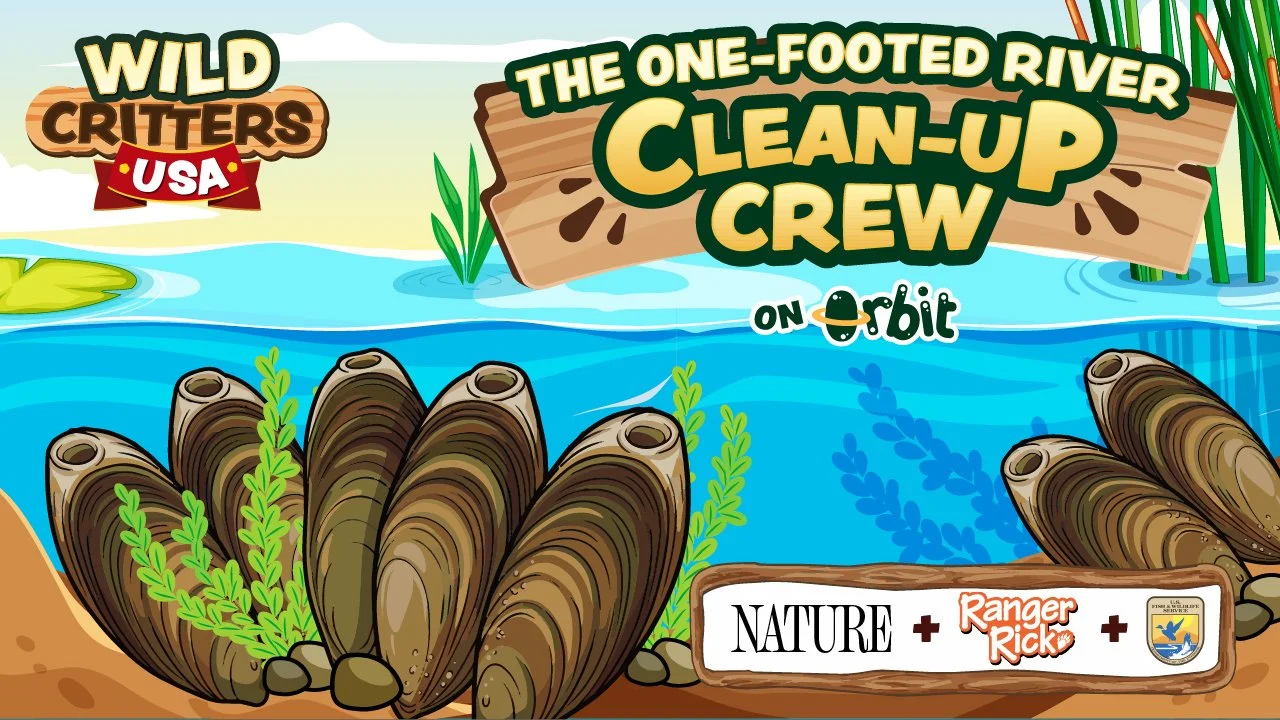
How do freshwater mussels clean rivers?
Meet the tiny animals keeping streams healthy
🎧 Listen on your favorite platform (LINKS).
🤝 This episode is part of Wild Critters USA, a collaboration between Orbit, PBS Nature, and the National Wildlife Federation.
Did you know that some of the most important animals in a river spend most of their lives buried in mud? Freshwater mussels may not look exciting at first glance, but these little shellfish help clean water, create habitat for other animals, and play an important role in keeping rivers healthy.
In this episode of Orbit: Science for Kids on the Move!, we explore the fascinating world of freshwater mussels with Tyler Herrin from the U.S. Fish and Wildlife Service. Discover how mussels filter water, why baby mussels hitchhike on fish, and how scientists are working to protect these remarkable animals.
Vocabulary and Concepts from the Episode
Freshwater Mussel: A shellfish that lives in rivers, streams, and lakes.
Shellfish: An animal with a shell but no backbone.
Gills: Structures that help animals take oxygen from water.
Siphon: A tube-like body part that pulls water into and out of a mussel.
Glochidium: A tiny baby mussel that rides on a fish during part of its life cycle.
Mimicry: When an animal looks or acts like something else to trick another creature.
Fish Hatchery: A facility where scientists raise fish and other aquatic animals to support conservation.
The Science Behind the Episode
Freshwater mussels are sometimes called nature's water filters. They pull water into their bodies, remove tiny particles such as algae and dirt, and release cleaner water back into the river. A healthy mussel population can help improve water quality and support many other species.
Their life cycle is one of the most unusual in the animal kingdom. Baby mussels, called glochidia, must attach themselves to a fish and ride along for part of their development before dropping to the river bottom and growing into adults.
Because mussels are sensitive to pollution and changes in river habitats, scientists often use them as indicators of ecosystem health. When mussel populations decline, it can be a sign that a river is in trouble.
What Your Child Will Learn
What freshwater mussels are and where they live.
How mussels help clean rivers and streams.
Why mussels are not actually fish.
How a mussel's foot helps it move.
How mussels sense the world around them.
Why baby mussels hitchhike on fish.
How mimicry helps mussels survive.
How scientists protect mussels through conservation hatcheries.
Big Questions About Freshwater Mussels
What is a freshwater mussel?
A freshwater mussel is a shellfish that lives on the bottoms of rivers, streams, and lakes.
How do mussels clean water?
They filter water by pulling it into their bodies and removing tiny particles before releasing it back into the river.
Are mussels fish?
No. Mussels are shellfish and do not have backbones.
What is a mussel's foot?
A mussel's foot is a strong, tongue-shaped muscle that helps it move through mud and sand.
What is a glochidium?
A glochidium is a baby mussel that temporarily rides on a fish as part of its life cycle.
Why are freshwater mussels important?
They help keep rivers healthy, provide habitat for other animals, and can tell scientists whether a river ecosystem is thriving.
About the Expert
Tyler Herrin is a Hatchery Complex Manager with the U.S. Fish and Wildlife Service. He oversees Erwin National Fish Hatchery and Chattahoochee Forest National Fish Hatchery, where he helps conserve freshwater species and protect healthy river ecosystems. Tyler works with scientists and conservation teams to raise and restore freshwater mussels and other aquatic wildlife.
Why STEM Podcasts for Kids?
STEM podcasts help children build curiosity, science vocabulary, and confidence asking questions. They also provide a screen-free way for families to learn together, turning car rides, quiet time, and everyday moments into opportunities for discovery and conversation.
About Orbit: Science for Kids on the Move!
Orbit: Science for Kids on the Move! is a science podcast for curious kids ages 3–11 featuring real experts, kid questions, and fun storytelling.
Each episode helps children explore animals, weather, space, technology, engineering, the human body, and the natural world while building curiosity, science vocabulary, and confidence in learning.
Perfect for:
Car rides
Quiet time at home
Screen-free afternoons
Family adventures
Learning on the go
More from Cumbre Kids
Cráneo: Ciencia para niños curiosos (Español)
A Spanish-language science podcast where curious kids explore the world through questions, storytelling, and conversations with real scientists and experts.
Buenas Noches, Cráneo: Historias para dormir (Español)
A calming bedtime podcast in Spanish featuring gentle stories, imagination, and relaxation designed to help children wind down for sleep.
🎧 Explore all of our podcasts: https://www.cumbrekids.org

Why STEM Podcasts for Kids?
Research shows that podcasts like Orbit: Science for kids on the move! help kids build early STEM identity while sparking curiosity and imagination about the world around them. By hearing real experts and big questions, children begin to see themselves as scientists.
They also offer engaging, screen-free entertainment—perfect for car rides and on-the-go learning—while growing science vocabulary, strengthening critical thinking, and introducing kids to real-world STEM careers in a fun, accessible way.