

Kids ask: Why don’t we always make good decisions?
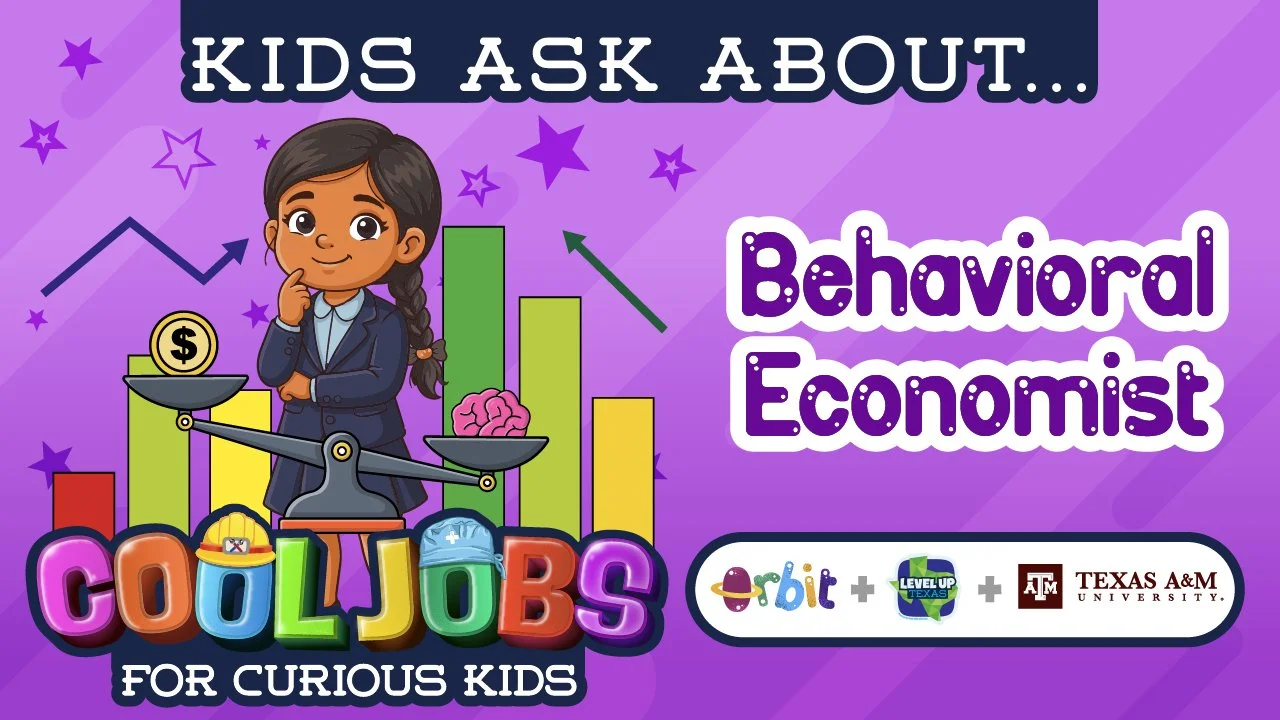
The Science of Choices & the Brain for Kids (Ages 3–11)
Links to Listen: Spotify, Apple Podcasts, More platforms
This episode is part of the Cool Jobs for Curious Kids series, exploring 8 STEM careers and the science behind their job. Produced with LevelUp Texas.
Submit questions for episodes here.
In this thought-provoking episode of Orbit: Science for Kids on the Move, kids explore how we make decisions with Dr. Marco Palma, a behavioral economist and director of the Human Behavior Laboratory at Texas A&M University.
Through relatable examples—like choosing between two favorite shirts or deciding whether to eat candy now or later—Dr. Marco explains how our brains weigh choices, handle trade-offs, and balance emotions with logic. Kids learn about the “right now” part of the brain that wants immediate rewards and the “careful” part that thinks about long-term consequences.
This episode introduces core concepts from economics, psychology, and neuroscience, helping kids understand how decisions are made, why they can feel hard, and how to make better choices over time.
Episode Vocabulary
Build science language while you listen!
Decision: Choosing between different options
Economics: The study of how people make choices when they can’t have everything they want
Trade-off: Giving up one thing to get another
Behavioral Economics: The study of how emotions and behavior affect decisions
Brain: The organ that controls thinking, feeling, and decision-making
Prefrontal Cortex: The part of the brain that helps with planning and thinking ahead
Instant Gratification: Wanting a reward right away instead of waiting
Emotion: A feeling like happiness, fear, or anger that can affect decisions
Experiment: A test scientists use to learn how things work
Children’s questions in this episode
Submit questions for upcoming episodes here.
What is a decision?
What is economics?
How does the brain make decisions?
What are the “right now” and “careful” parts of the brain?
Why do we sometimes make decisions we regret?
Why are some decisions harder than others?
How do emotions affect our decisions?
Why is it harder to decide when we are tired, hungry, or stressed?
How can we make better decisions?
How do scientists study decisions?
What is a behavioral economist?
What jobs involve studying decisions?
How can kids become economists someday?
After listening: conversation starters
What is a decision you made today, and what were your choices?
When have you felt “right now” vs. “careful” thinking?
What is one decision you could think about using the 10-10-10 rule?
About the expert
Dr. Marco Palma is a professor in the Department of Agricultural Economics in the College of Agriculture and Life Sciences at Texas A&M University and Director of the Human Behavior Laboratory. His areas of interest are consumer economics, experimental and behavioral economics and neuroeconomics.
Why STEM Podcasts for Kids?
Research shows that podcasts like Orbit: Science for kids on the move! help kids build early STEM identity while sparking curiosity and imagination about the world around them. By hearing real experts and big questions, children begin to see themselves as scientists.
They also offer engaging, screen-free entertainment—perfect for car rides and on-the-go learning—while growing science vocabulary, strengthening critical thinking, and introducing kids to real-world STEM careers in a fun, accessible way.